So. What did I learn today? I learned that I am terrified to write. Not write in this informal, bloggy sort of way or even in an academic way (I actually really enjoy writing academic papers), but write in a real way. A way that makes me push my creative limits and a way that leaves me vulnerable to my audience. I am terrified that I am going to produce crap. And if writing shows who we are and my writing is crap, then does that mean I am Miss Craptacular? I don't know or maybe I'm too scared to find out.
Take the open mic today (and even my institute piece in general)...it was something that I had previously worked on in another class and something that I had already revised multiple times. It was safe. If I had been more secure in my creative writing ability or perhaps even more secure in myself, I would have shared something from my daybook or something new altogether. But I am cripplingly insecure about my writing, which leads me to my next question...
Am I a fraud? Not a fraud in the identity thief or 90s poser sort of way, but a writing fraud. Every day in my classroom, I espouse the importance of just getting something down on the page and not being scared to write crap. I extol the virtues of writing, reflecting, and writing again. I applaud my students who are willing to share the most intimate corners of their mind. And yet, I am terrified to do those very things.
I have to somehow use this final week of Summer Institute to figure out a way to suck it up and BE a writer. Not talk like a writer. Not act like a writer. Not think like a writer. But BE a writer.
I think that will be my goal for the weekend. I am going to write something new. I am going to try to BE a writer...craptacular or not.
This is me promising to write something new in my daybook at some point this weekend. I usually hate pictures of myself so I took a self-pic as sealing the writing promise. Consider it the same as if we just did a spit shake :)
Have you ever noticed that radio stations always play the same songs when it's raining outside? I mean, at some point on your ride home today you probably heard at least one, if not all of the following: CCR's "Who Will Stop the Rain?" or GnR's "November Rain" or or the Eurythmics' "Here Comes the Rain Again" or CCR's "Have You Ever Seen the Rain?" or Dylan's "A Hard Rain's A-Gonna Fall." For me, my favorite rainy day song is "Riders on the Storm" by The Doors and so it's my video for my blog post today. Enjoy!
Even though I am going to talk a little bit more about the
demos from today in a bit, my biggest revelation for today is that I LOVE MY
WRITING GROUP!!! I have to thank Lacy and Steve for picking out a group of some
awesome partners-in-crime AND really good colleagues as well. I’ve really had a
lot of fun getting to know everyone and I have learned so much from them. So
Grouping Gods, you did a great job!
I know you can't read this, but our Skype conversations are hilarious.
Even as I am typing this at home, we are still talking to each other on Skype.
As far as the demos, I really enjoyed Kim’s demo this
morning on what is a hero and I think that it would be a great way for me to
introduce the concept of inquiry in my own class. I think the demo did a
fantastic job of showing how to take a big idea question (which most inquiry
questions begin as), locate the conversation, respond to the conversation, and
find a place to stand among it. I also really enjoyed Ben’s demo even though he
made me do creative writing, which I am TERRIBLE at! (If you want proof, my
best/most creative work from today is the caption underneath the picture).
"Nice to meet you too. You can call me, Ishmael."
(Terrible, I know!)
I think that I will use something very similar to his demo
along with the one that I did on good writing to complicate this notion or
narrative of what writing is at the beginning of the semester. I think that I
may change their first thought piece to be what their definition of writing is
based on what they learned from our discussions/activities and then also what
they find out from other people’s definitions. It could be a little
mini-inquiry on the nature of writing and I think it would be really cool.
Maybe have them record people’s ideas, incorporate quotes, etc. SORRY!!! I was
just writing through my ideas here.
Back to Ben’s demo: I LOVED the part where
we intentionally made our writing bad, but when we shared it around the circle,
we starting valuing it more. It’s funny how the worst ultimately became the
best, which gives credence to the notion that all of these definitions of what
is “good writing” or “bad writing” are completely arbitrary. If any of you are interested in writing badly, there is a
contest I talked about in one of my earlier posts. It’s the one that inspired
Snoopy’s “It was a dark and stormy night” and you can find the information here
or check out the photo below:
Overall, I think that today went extremely well because it
was over before I knew it. I can’t wait to see what’s to come tomorrow J
Well, since Nick and I basically spent our entire day coming up with our Day in the Life, I think that it's only appropriate that it's my post for tonight. I'm not sure exactly how the Willy Wonka theme came up, but it really works for what we are doing in Summer Institute. It seems like in order to be good writing teachers, we have to take on that role of Willy Wonka--the guy who forces you to think in new ways and to look at things from a different perspective--the guy who pushes you to show who you really are and what you are capable of. I don't know...maybe that's too cheesy, but it's what I was thinking about for today. ***Also, please know that most of the creative genius points go to Nick!
Our version of the song: Come with me and you'll be in a world of teacher edification. Draw your pic and Miss Jenny will use fuhnetik pron unz e ashun We'll begin human statuin' Traveling in tableau improvisation. Has technology brought us more a-li-en-ation? If you want to receive good advice Simply look around and hashtag it Anything you want to, do it Wanna change the world? Tweet the NWP #nothingtoit There is no breakfast I know to compare with Summer Institute-ation. "NWP muffins for free: choc-o-late or blue-ber-ry?" If you want to browse JSTOR sites Simply look around and view it Anything you want to inquire, do it Wanna enter conversations? Just Skype Lil, she can do it Blogging goes oh so slow when you're using 49er wireless. Squeaky chairs bother me. A day in the life of NWP.
And the AWESOME memes won't load now, but I'll get them up here as soon as I can :)
I’m not sure if things felt off today because I was sitting
in the opposite corner of the room and the new vantage point threw off my mojo
OR if it was off because my attention kept being distracted (remind me not to
sit beside Nick next time!), but
something seemed off for me today. Even
though I felt a little discombobulated, what we did today was so interesting to
me. I think that Sally’s modeling of the Socratic Seminar was exemplary and Lil’s work with Envy (especially the Body
Biography) is something that I cannot wait to implement. Check out our group’s
Body Biography below:
What really spoke to me today was Lacy’s work with Not Your
Mama’s Grammar and complicating the notion of conventions. What I took away
(and I think that it is a derivative of something Sarah Davis said) is that
grammar should be used as a set of tools rather than a set of rules. I have
always been REALLY curious about grammar instruction and what is the best
method for our students. I’m actually writing my graduate project on the “Great
Grammar Debate” and whether or not we (college composition) should explicitly
teach it in our classrooms. I created a site for my directed reading last
semester on it and here is the link (http://kandre17.wix.com/thegrammardebate) if you want to check it out. The site
itself may be a little boring, but there is a tab called “Review of Research”
and that has an annotated list of the most well-known articles on this topic.
If you’re interested in reading more on whether or not we should be teaching
grammar, you should check it out! At least you can save yourself some research time :)
And if you want to check out an interesting video, please watch the one below. It's based on Newsweek's 1975 article, "Why Johnny Can't Write" that created the illiteracy scare/writing crisis of the 1970s. It's really interesting to see what role popular media can play in the way America thinks about writing and ultimately about our teaching practices.
Another thing I was thinking about was the connection among
grammar, speech, and writing. I recognize that we don’t use grammar in our
speech by internally flipping through the grammar files in our brain each time
we create a sentence or suspect a problem—it just happens naturally. What I
think we need to remember too is that the language we use in speech is often very
different from the language we use in writing because speech and writing are
two very different modes of communication. Speech is usually more spontaneous,
interactive, and context-bound whereas writing is usually more concretized,
structured, and context-independent. In other words, you use speech on the fly
and what you say depends on who you are talking to and in what context. Now
context and audience most certainly play a MAJOR role in writing, but what is
unique to writing (over spontaneous speech) is that it can transcend the
original audience and context (anyone can read it in any context) and yet it
maintains exactly what has been written (concretized). I just wonder if the
nuanced differences between speech and writing should be considered more when
we often use them interchangeably.
And I'll leave you with this video since we were talking about Grammar Nazis in our group:
In order to set the tone for today’s post, I tried to think
about what video I can put up here that expresses my mood right now. I was
having a hard time, but I came across this cool video:
And I had to include it, so enjoy! Even though Steve’s
revision section today and Mary Ellen’s demo on re-purposing were fantastic, I
couldn’t help but think about all things digital for most of the day. I don’t
know if it’s because one of my primary research interests is emergent digital
genres or because it’s just really interesting, but I have a fascination with
all things digital. I think that we are on the brink of something so new,
exciting, and even revolutionary in writing with the changes inherent with the
digital medium. What most interests me is how these new genres have such
different conventions from their paper counterparts.
For example, the digital
essay is not just a standard essay created in a digital space. A digital essay
should make use of all the affordances that a digital space creates such as the
ability to link, to use images, to use video and audio AND it needs to use the “web-like”
affordances of the internet by showing connections rather than remaining on a
linear plane as a traditional essay would. That means that the digital essay
wouldn’t have a traditional introduction at the top, conclusion at the bottom,
and body content in between, but rather the digital essay should be able to
rely mostly on content that could be accessed through tiled tabs or in a larger
space. If you want to check out a digital essay that I wrote on Bob Dylan, you
can access it here: http://kandre17.wix.com/dylanandrhetoric. I’m not saying it’s the right way to write a digital essay or even a good way, but it’s a way that
I tried it.
As far as my digital project, I thought it was
so hard! I used Prezi for the first official time (I’ve tried at least ten
times before and given up) and trying to figure out how to work it felt like I
was doing this:
But after a lot of hard work and a lot of swearing, I
finished it up in the wee hours of Monday morning. I haven’t quite figured out
how to create a link for it so that will be forthcoming; however, here is a screenshot for now:
Even though it was a
lot of work and a lot of confusion, I’m really glad we did it because it pushed
me to learn a new genre as well as my trajectory as a teacher. I also think that the gallery crawl with the sticky notes was a great way to give feedback to everyone and I can't wait to use that in my class. It was such a great feeling to come back to your computer and see it filled with great comments:
Side note: During all my random surfing for my
initial video, I came across this 1984 Apple commercial that introduces the
Macintosh computer. It is amazing! I would love to spend hours and hours
dissecting it (especially the big brother part and how that is so appropriate
for today too), but I wanted to know what you guys thought!
Today was a good day. Even though I had been stressing over
and worrying about doing my demo for weeks now, I have to say that it went much
better than expected (there were no judgmental stares, snide questions, or
natural disasters) and I think that we were able to get a good conversation
started.
That’s what is really the most important aspect of the demo for me:
having a conversation about how we view good writing. I don’t necessarily have
an answer or think that we should throw out these rules as we have always known
them, but I do think that we need to complicate the notion itself and consider
the possibility that these rules are much more malleable than we may think. If
we look at writing only through the lens of these unbreakable rules, then we
may be missing out on the more visceral or felt sense of writing. (That’s
hopefully what the groups noticed as they were forced to rank certain pieces of
writing in a certain way according to the rules). If we had extra time, I would have liked to read "What Writing Is" by Stephen King, which comes from his memoir On Writing. I love how he defines writing and how we should approach it, and I think that it would be well worth your time to read it--my students love it just as much as I do (it's not only funny, but he really has good things to say).
Also, I
probably would have shown this video made by some journalism students on the oh-so
lauded and hated Elements of Style byStrunk and White.
Even though the video is kind of overdone at times, it can
show that even the most widely accepted experts on style can be ridiculous too.
We also would have spent more time
talking about each of the pieces individually and discussed how each one could
function as an example of good writing, which would lead into an even larger
discussion of genre, purpose, audience, tone, etc. (Interesting note: the “Itwas a dark and stormy night” piece is what Snoopy is usually writing as his
masterpiece in the Peanuts cartoon and it is generally thought to be one of the
worst opening lines to a novel ever. They even have annual contests named after
the author where contestants try to write even worse ones...might be kind of fun...)
Overall, the teacher demonstration was a great experience
for me and I learned so much from listening to everyone in class. I especially
appreciated Wendy’s comments on how these conversations may not be the most
practical for certain students/what do you do when you are bound (by pay and
testing) to these rules. I don’t have the answer to those questions yet, but it
certainly got me thinking and I always appreciate anything that helps me
complicate my thinking in new ways. I am including the text from my lesson plan
below along with notes and pictures in case you may want them for any
adaptations. Thanks so much!
What is Good Writing?
A Game of Belief and Doubt
“The truer it seems, the harder you have to doubt it” (Peter Elbow)
Writing into the Day:
Throughout our schooling career, we are
repeatedly given examples of “good writing” and we are constantly reminded of
the “rules for good writing.” I want you to spend today’s daybook time making a
list of these examples of good writing and trying to remember some of these
rules that you have been told are true and maybe even some that you also
believe to be true. Then try to use those rules to create a personal definition
of both good writing and bad writing.
Getting into Groups: Group Configuring with Composer Cards (novelists, poets, movie directors, screenwriters, cartoonists, lyricists, visual artists, etc.)
I try to get my students into random groups
as much as possible during the first few weeks of class before we move into
assigned writing groups. I like this method because they have to talk to each
other to figure out who they are and where they belong. However, I also will
use playing cards and match them by suit or number.
Cooperative Work:
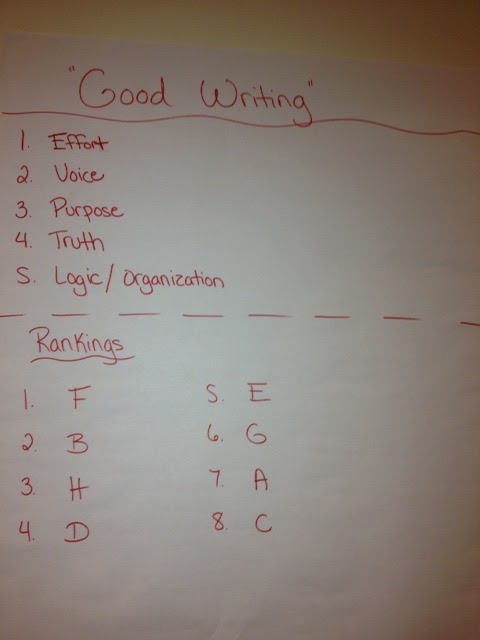
Once in groups, you must share the rules and
definitions that you wrote in your daybook to the rest of the members. After
everyone has shared, you must collectively (everyone must agree!) decide on 4-5
rules for good writing that you have been told and will believe to be true.
Please make sure that you record these rules in order of significance.
Posters from the Groups:
Once the
rules have been recorded, you must read and examine the eight different writing
samples that I have given you.
The eight pieces were a comic on writing by comic theorist Scott McCloud, the DVD synopsis/blurb for One Flew over the Cuckoo's Nest (I try to use a movie the students may not know), an excerpt from Plato's Allegory of the Cave, Hamlet's "To be or not to be" Soliloquy from Shakespeare, the infamous opening line from Edward Bulwer-Lytton's Paul Clifford, the directions from Crest Whitening Strips (directions to children's games like Candy Land work well too), the lyrics to "Smells like Teen Spirit" (chosen because they are messy and seem discordant, but the lyrics are representative of a generational shift), and the last piece comes from James Gee's discussions on Discourse or an excerpt from a theorist like Michel Bakhtin or Jacques Derrida. Of course, you could choose any pieces you like, but these are the ones that have worked for me.
According
to the rules that your group created, rank each of these pieces in order of
their “quality” (along the spectrum of good writing to bad writing). Then,
record your ranking on your group’s sheet and explain why you ranked or had to
rank each piece in its particular position.
Circle Up and Share Out:
Each group will share and explain their
rankings. Then, we will take a moment to see if we can complicate things a bit
and I would also like for the group to comment on any of the following
questions:
*What rules do we all seem to agree on? Where does this
agreement come from?
*Why do we have the preconceptions about writing? How
may it change once you go outside of this particular classroom?
*Why may it be important to know “the rules” of “good
writing” first? Do you have to understand something before you subvert it?
*What is dangerous about setting up a distinct
dichotomy of good vs. bad?
*How do audience, genre, medium, style, and purpose
play into this?
*Is good writing based on what it produces in the
reader? If they want to engage and not put it down? Emotionally charged?
Factual? Argumentative?
*How do these rules function in the
context of professional writers? Do professional writers follow these rules?
*Try to think of these rules on a
broader level. What kind of function or purpose do they serve? Should everyone
follow them? Do they work in all situations? Do they privilege certain people? Is
it the intention to privilege certain people?
*And most importantly, why do you
think that this notion of rules for good writing persists?
Returning to our Thoughts:
Take a few minutes to respond to your initial definitions of
good writing. Did this particular activity affect your previous thinking? Why
do you think the notion of good writing persists? How will it affect you as a
teacher? How will it affect you as a writer? How could you apply Elbow’s ideas
of belief and doubt into your own teaching practices?
Theoretical Framework:
The believing and doubting game can
be found in the appendix of Peter Elbow’s Writing
Without Teachers (1973). Essentially Elbow is asking the reader not only to
doubt what she is reading (look for error, assume that something is wrong,
develop a contradictory opinion), but also to believe what she is reading
(project herself into the writer’s perspective). There needs to be a balance of
both doubt and belief to really read and understand a piece of writing. (**Please keep in mind that this is a reductionist version of this theory and there is much more to it than I have described here**) You can see some of Peter Elbow's ideas on writing here:
The following is just a fun thing that one of my students sent me after we did this exercise:
When in doubt, just try to remember the rules on HOW TO WRITE GOOD:
1.AVOID ALLITERATION ALWAYS
2.PREPOSITIONS ARE NOT WORDS TO END
SENTENCES WITH.
3.THE PASSIVE VOICE IS TO BE AVOIDED.
4.AVOID CLICHES LIKE THE PLAGUE.
THEY’RE OLD HAT.
5.IT IS WRONG TO EVER SPLIT AN
INFINITIVE.
6.WRITERS SHOULD NEVER GENERALIZE.
Seven: BE CONSISTENT
8. DON’T USE MORE WORDS THAN NECESSARY. IT’S HIGHLY
SUPERFLUOUS.
9. BE MORE OR LESS SPECIFIC.
10. EXAGGERATION IS A BILLION TIMES WORSE THAN
UNDERSTATEMENT.


.jpg)
.jpg)
.jpg)
.jpg)


.jpg)
.jpg)
.jpg)


.jpeg)




.jpeg)
.jpeg)
.jpeg)


